
Ductless Mini Split Repair in Orlando
Ductless mini splits are common in Orlando additions, garages, converted spaces, guest suites and Florida rooms. They are efficient and quiet, and they fail differently from central systems — with error codes instead of silence, and with maintenance needs that are easy to neglect because there is no filter in a hallway to remind you.
Requests are coordinated through our Orlando office at 5401 S Kirkman Rd, Suite 3310.
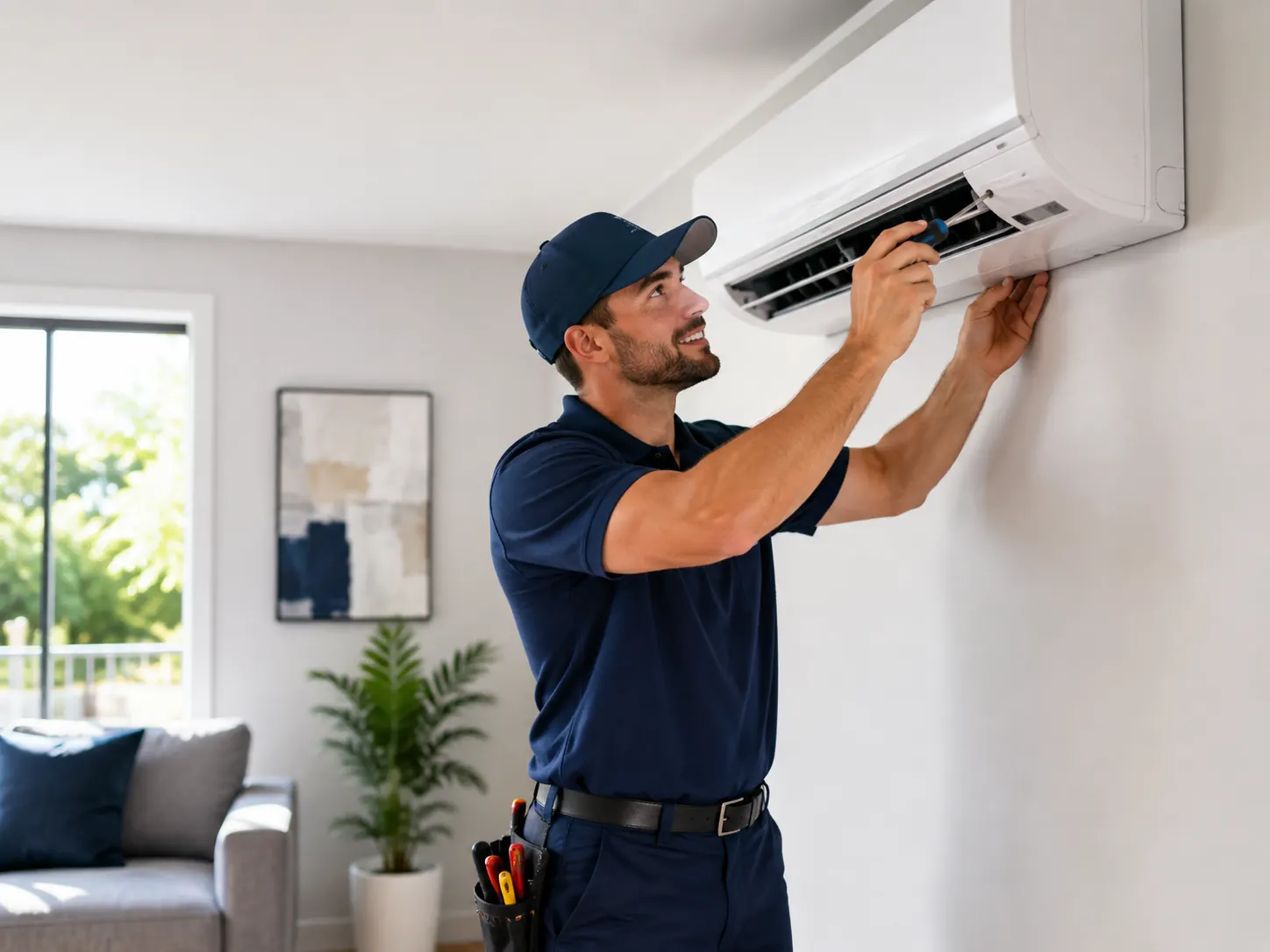
Short answer
The most frequent mini split problems are restricted airflow from dirty filters and a fouled blower wheel, gravity-drain condensate blockages, and electronic faults reported as blinking-light error codes. Note the code pattern before requesting service — it meaningfully narrows the diagnosis.
Symptoms we hear about
- Blinking indicator lights or an error code on the indoor head
- Water dripping from the indoor unit onto the wall or floor
- Musty smell when the unit starts
- Weak airflow even at high fan speed
- Unit runs but the room does not cool
- Outdoor unit not running while the indoor head is on
How mini splits differ from central systems
A ductless system pairs one outdoor unit with one or more indoor heads connected by refrigerant lines, a control cable and a condensate drain. There is no duct system, so distribution problems disappear — and so does the tolerance for a dirty indoor unit, because the coil and blower are in the room with you.
- Inverter-driven compressors modulate capacity instead of cycling on and off
- Communication between indoor and outdoor units is electronic, so faults are reported as codes
- Condensate usually drains by gravity through a small line with no pan under the head
- Filters are thin washable screens, not disposable cartridges
- Line-set penetrations and drain routing are installation-quality dependent
Airflow and the blower wheel problem
The single most common mini split complaint is weak cooling caused by fouling. Because the indoor head handles room air continuously and its filters are light-duty screens, dust and biological film accumulate on the barrel-style blower wheel and the coil fins.
The result is progressive: airflow declines, the coil runs colder, dehumidification suffers, and eventually the room simply does not cool. Rinsing the screens helps but does not clean the wheel. Restoring performance typically requires a deep cleaning of the coil and blower, often with the head covered and flushed on a bib — real work, not a wipe-down.
- Rinse the washable filter screens every few weeks in heavy use
- Have the coil and blower wheel professionally cleaned periodically, especially in dusty or pet-heavy spaces
- Do not spray household cleaners into the head; overspray reaches electronics
- Address musty odor early — it indicates growth on a wet coil and in the drain
Water dripping from the indoor head
Mini split heads have very little internal drain pan capacity, so a partially blocked gravity drain shows up quickly as water on the wall. Causes are usually one of the following.
| Cause | What is happening |
|---|---|
| Clogged drain line | Biological slime narrows the small-diameter line until water backs up |
| Insufficient slope | Drain routed without continuous fall, so water sits and eventually overflows |
| Head not level | Water is pushed to one side of the pan and past it |
| Blocked line-set sleeve | Debris or a kinked drain inside the wall penetration |
| Condensate pump failure | Where a pump is required because gravity drainage is not possible |
| Frozen coil thawing | Ice melting faster than the drain can carry it away |
Turn the head off if it is dripping, place a towel to protect flooring and drywall, and request service. The related central-system version of this problem is covered on AC leaking water.
Error codes and electronic faults
Mini splits self-diagnose. The indoor head reports a fault by blinking its operation, timer or defrost lights in a specific pattern, or by displaying a code. Patterns are manufacturer-specific, which is why writing down what you see matters.
- Note which light blinks, how many times, and the pause interval
- Note whether the outdoor unit runs at all when the fault appears
- Note whether the fault is immediate or appears after several minutes of running
- Note whether it clears on a power cycle and how long before it returns
Common categories behind those codes include indoor and outdoor sensor faults, communication loss on the interconnecting cable, inverter or IPM board faults, outdoor fan motor problems, and refrigerant pressure or temperature protection trips. Sensor and communication faults are frequently repairable; inverter board failures on older units raise a value question similar to the one on AC replacement.
Installation quality problems that surface later
Mini splits are sensitive to installation practice, and a meaningful share of repair calls trace back to how the system was put in — sometimes years earlier.
- Inadequate evacuation, leaving moisture and non-condensables in the system
- Flare connections that were over- or under-tightened, producing slow refrigerant leaks
- Line-set length or lift beyond specification without charge adjustment
- Drain routed with rises or dips instead of continuous fall
- Undersized or oversized head for the room, hurting humidity control
- Outdoor unit placed where discharge air recirculates or where debris collects
Slow flare leaks are the classic delayed symptom: cooling gradually weakens over a couple of seasons. See refrigerant leak repair for why topping off is not the answer.
Cost planning for ductless repair
| Work | Typical planning range |
|---|---|
| Diagnosis with a minor part or sensor | $150–$450 |
| Drain clearing and deep coil and blower cleaning | $300–$900 |
| Refrigerant leak repair at flares with recharge | $350–$1,500+ |
| Outdoor fan motor or major board | $700–$2,500+ |
| Compressor or inverter compressor failure | $1,500–$3,500+ |
Multi-zone systems add complexity because one outdoor unit serves several heads, so faults can present in one zone while originating elsewhere. Model your scenario on the cost page; these are planning ranges, not quotes.
Ductless Mini Split Repair questions
- Why is my mini split blinking?
- Blinking lights are how ductless systems report a fault code. Patterns vary by manufacturer and can indicate sensor failures, communication loss between the indoor and outdoor units, inverter board faults, or a protection trip. Record the blink pattern and whether the outdoor unit runs — it shortens diagnosis considerably.
- Why is my mini split leaking water inside?
- Almost always a condensate drainage problem. The small gravity drain clogs with biological growth, or it was installed without continuous slope, or the head is not level. Turn the unit off to prevent wall and floor damage and request service; these heads hold very little water internally.
- How often do mini splits need cleaning?
- Rinse the washable filter screens every few weeks during heavy use. Beyond that, the coil and blower wheel need periodic professional deep cleaning — more often in dusty spaces, homes with pets, or garages and workshops. Fouling is a common cause of weak mini split performance.
- Can a mini split be repaired or does it need replacing?
- Sensors, drains, fan motors, boards and leaking flare connections are all commonly repaired. The harder decisions involve inverter compressors and main boards on older units, where the repair can approach the cost of new equipment for that zone. Age, zone count and parts availability drive that call.
- Why does one room's head cool while another does not?
- On a multi-zone system that pattern points to something specific to the affected head or its branch: a fouled blower wheel, a failed indoor fan motor, an expansion valve or branch-box issue, or a communication fault. Since both heads share one outdoor unit, a working zone helps rule out several possibilities.
- Do mini splits handle Florida humidity well?
- Generally yes, because inverter operation produces long low-capacity run times that remove moisture. That advantage disappears if the head is oversized for the room or if the coil and blower are dirty, both of which shorten run time or reduce airflow across the coil.
- Is a mini split a good option for a garage or addition?
- It is often the best option, since extending central ductwork to an add-on space rarely performs well and can unbalance the whole house. Sizing for the space and its heat gain matters, and garages need realistic expectations about insulation and door openings.
Talk through your AC problem
Describe what the system is doing and ask about current service availability in your part of the Orlando area.
5401 S Kirkman Rd, Suite 3310 · Orlando, FL 32819