
AC Electrical Repair in Orlando FL
Electrical components cause more sudden air conditioning failures than any other category. They are also the components homeowners should never touch: capacitors store energy after power is removed, disconnects and contactors carry line voltage, and a mistake here causes injuries rather than inconvenience.
Requests are coordinated through our Orlando office at 5401 S Kirkman Rd, Suite 3310.
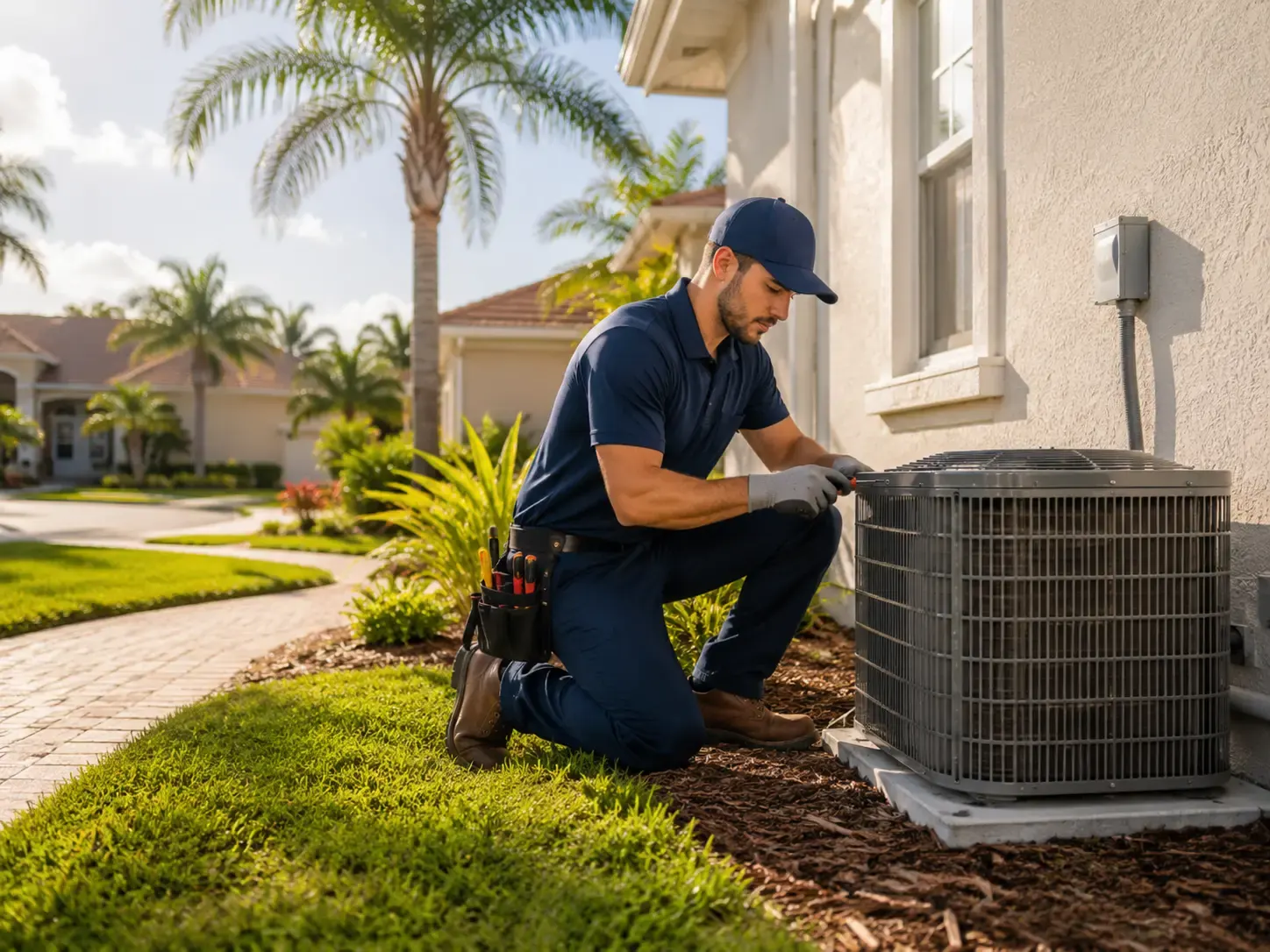
Short answer
The most common electrical failures are run capacitors, contactors, and motor-related faults that trip breakers. A system that hums without starting, trips a breaker on start, or is completely dead at the outdoor unit is an electrical diagnosis. Turn the system off and request service rather than repeatedly resetting the breaker.
Symptoms we hear about
- Outdoor unit hums but neither the fan nor compressor starts
- Breaker trips whenever cooling is called
- Clicking or buzzing at the outdoor unit's electrical compartment
- Burning or hot-plastic smell near equipment or the disconnect
- Thermostat dark and system entirely unresponsive
- System stops and restarts several times an hour with no pattern
The components that fail most often
Run capacitors
Capacitors provide the phase shift that lets single-phase motors start and run efficiently. They degrade with heat, and Central Florida's long cooling season gives them plenty of it. A weak capacitor causes hard starting, higher amp draw, motor overheating and eventually a compressor or fan that will not start at all. Capacitance is measured with a meter; visual inspection alone is not reliable, though a bulged top is conclusive.
Contactors
The contactor is the relay that connects line voltage to the compressor and condenser fan when the thermostat calls. Contacts pit and burn over thousands of cycles. Symptoms range from an outdoor unit that will not start to one that will not stop, because welded contacts can hold the circuit closed even with no call for cooling.
Motors
Condenser fan and blower motors fail electrically through winding faults and mechanically through bearing wear. A motor with failing bearings draws more current, runs hotter, and often trips a breaker or thermal overload before it stops entirely. ECM blower motors add control modules that can fail independently of the motor.
Transformers, boards and low-voltage circuits
The 24-volt control side has its own failure points: transformers, control boards, relays, safety switches and the thermostat wiring itself. A blown low-voltage fuse is a symptom of a short somewhere in that wiring, not a random event. See thermostat repair for the control-side view of these faults.
Disconnects, breakers and wiring
The outdoor disconnect box and the breaker feeding the unit are common trouble spots, especially where heat, moisture and corrosion combine on lugs and terminals. Discoloration, melted insulation and a scorched smell at a disconnect are urgent findings, not maintenance items.
Why breakers trip and why resetting is the wrong reflex
A breaker trips because current exceeded its rating or a fault was detected. That is protective behavior. Repeatedly resetting it forces the same fault current through the same components, adding heat to windings and contacts each time.
- A motor drawing high amps because of a weak capacitor or failing bearings
- A compressor attempting to start against locked-rotor current
- A winding shorted to ground inside a motor or compressor
- Damaged wiring, a failing breaker, or a loose connection generating heat
- Condenser airflow problems raising pressures and current draw
If a breaker trips twice, stop resetting it, leave it off, and request service. If there is any burning smell or visible scorching, leave it off and treat it as an emergency request.
What Florida conditions do to electrical components
Heat and humidity are the two ingredients that shorten electrical component life, and equipment here experiences both for most of the year.
- Long run seasons mean far more compressor and fan cycles per year than in mild climates
- High ambient temperature raises internal cabinet temperature, which accelerates capacitor degradation
- Humidity and rain drive corrosion at lugs, terminals and disconnects
- Summer storm activity brings voltage surges, brownouts and repeated restarts
- Salt-influenced air near water and coastal-influenced areas adds corrosion pressure
- A dirty condenser coil forces longer run times and higher current draw
This is why electrical testing belongs in annual AC maintenance rather than being treated as a breakdown-only concern. Measured capacitance and amp draw give real warning before failure.
What an electrical diagnosis measures
- Incoming voltage at the disconnect and at the unit under load
- Capacitor microfarad values against the rated specification
- Contactor coil operation and contact condition
- Amp draw on the compressor and both motors compared with data plate values
- Continuity and resistance in motor and compressor windings, including to ground
- Control voltage, transformer output and low-voltage fuse status
- Safety switch status: float switches, pressure switches and limits
- Terminal and lug condition, looking for heat damage and corrosion
Meaningful numbers should come back with the diagnosis. A component replaced without a measurement is a guess someone is charging you for.
Safety: what not to do
This is the section to take literally.
- Do not open the electrical compartment on the outdoor unit. Capacitors can hold a dangerous charge after power is off.
- Do not attempt to discharge, test or replace a capacitor without training and proper tools.
- Do not bypass, jumper or tape down a contactor to force the unit to run.
- Do not defeat a float switch, pressure switch or limit — those exist to prevent water damage and equipment destruction.
- Do not spray water into an energized cabinet while cleaning.
- Do not replace a breaker with a larger one to stop nuisance tripping. That removes protection and creates a fire risk.
The homeowner-safe scope is narrow: check the thermostat, check the filter, look at the breaker position once, and observe whether the outdoor fan turns. Everything past that is a service call.
Cost expectations
| Repair | Typical planning range |
|---|---|
| Capacitor replacement | $150–$450 |
| Contactor replacement | $300–$900 |
| Low-voltage fuse, transformer or wiring repair | $150–$600 |
| Condenser fan motor | $700–$2,500+ |
| ECM blower motor or module | $700–$2,500+ |
Electrical repairs are among the most favorable in HVAC because parts are frequently stocked and labor is short. Run your scenario through the AC repair cost estimator — planning ranges only, never a quote.
AC Electrical Repair questions
- What does it mean when my AC hums but does not start?
- Most often that the motor or compressor is receiving power but cannot start — classically a failed run capacitor, sometimes a failing motor or a compressor with a mechanical problem. Turn the system off rather than letting it keep attempting, because repeated failed starts add heat and electrical stress.
- Can I replace an AC capacitor myself?
- We do not recommend it. Capacitors store energy after power is removed and must be discharged safely, the compartment carries line voltage, and installing an incorrect value shortens motor life. This is a small, inexpensive professional repair — the risk is not worth the savings.
- Why does my AC breaker keep tripping?
- Usually because a motor or the compressor is drawing more current than the circuit allows, often due to a weak capacitor, failing bearings, a grounded winding, or high system pressures. Damaged wiring and a failing breaker are also possible. Leave the breaker off after the second trip and request diagnosis.
- How long do AC capacitors last?
- Manufacturers rate them for years of service, but heat is the deciding factor and long cooling seasons shorten real-world life. Many systems in this climate see capacitor replacement well before the equipment reaches end of life, which is why measuring capacitance during annual service is worthwhile.
- Is a burning smell from my AC an emergency?
- Treat it as one. Turn the system off at the thermostat and switch off the breaker feeding the unit, then request service. Overheating wiring, a failing motor and a scorched contactor can all produce that smell, and continuing to run the system raises the risk.
- Can a power surge damage my air conditioner?
- Yes. Surges and brownouts stress capacitors, contactors, transformers, control boards and compressor windings. If cooling stopped immediately after storm activity or a utility interruption, mention the timing — it focuses diagnosis on electrical and control components first.
- Why did my outdoor unit stop running while the inside fan still works?
- The indoor blower and the outdoor unit are on separate circuits and separate controls. The blower running while the condenser is dead points to the outdoor circuit, the disconnect, the contactor, the capacitor, or a missing 24-volt call reaching the unit — a straightforward electrical diagnosis.
Talk through your AC problem
Describe what the system is doing and ask about current service availability in your part of the Orlando area.
5401 S Kirkman Rd, Suite 3310 · Orlando, FL 32819