
AC Maintenance in Orlando FL
Central Florida equipment runs far more hours per year than the same equipment installed in a mild climate. Maintenance here is not seasonal housekeeping — it is the difference between a system that reaches its expected service life and one that fails in August with a bill nobody planned for.
Requests are coordinated through our Orlando office at 5401 S Kirkman Rd, Suite 3310.
Short answer
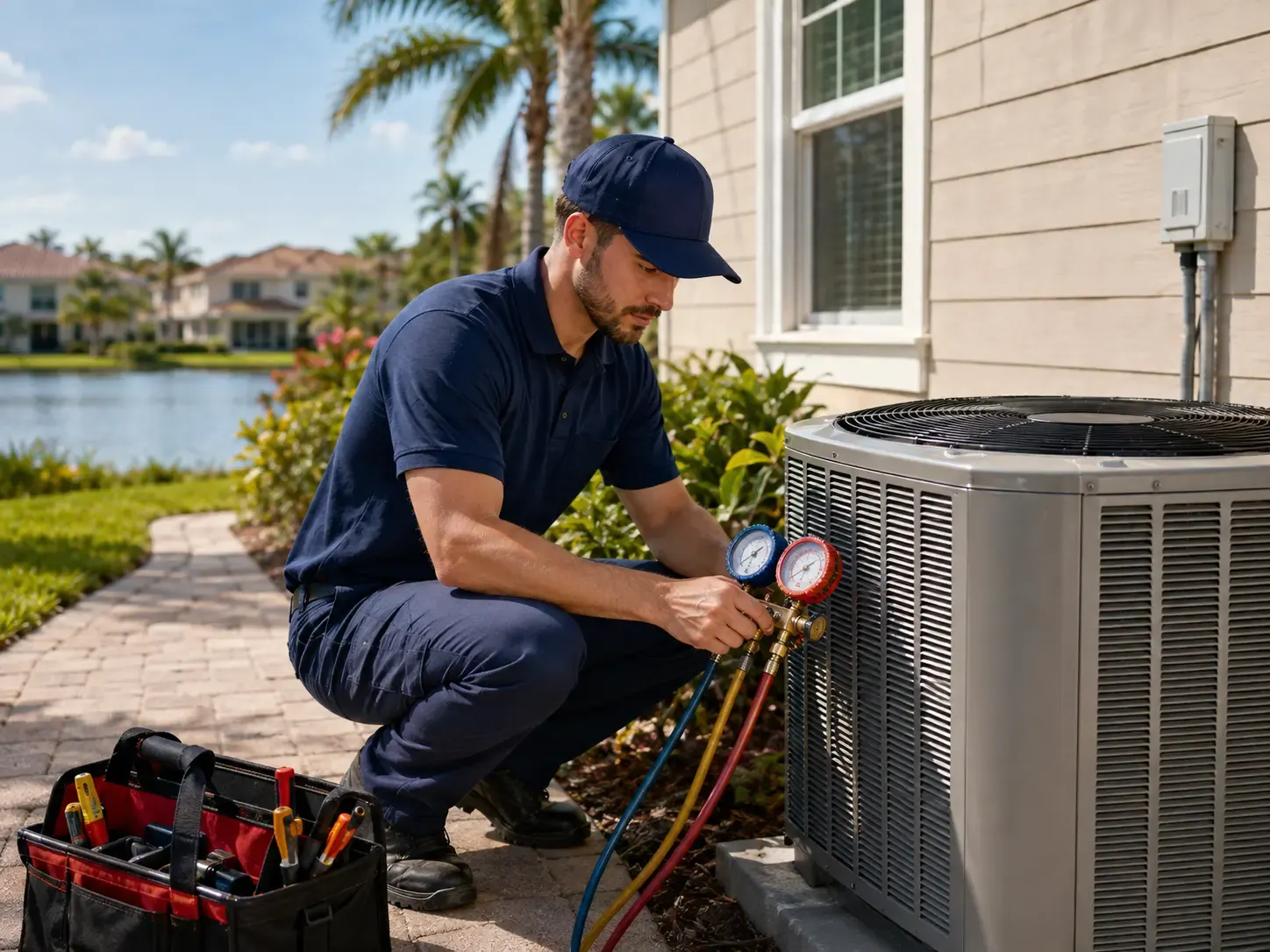
A meaningful tune-up measures rather than merely inspects: temperature split, static pressure, capacitor values, amp draw, superheat and subcooling, and condensate drainage. In this climate, service before the cooling season plus a mid-season check of the drain and filters is a reasonable rhythm.
Symptoms we hear about
- Run times getting longer for the same thermostat setting
- Rising electric bills without a rate change
- Musty odor when the system starts
- Weak airflow at registers farthest from the air handler
- Water staining near the air handler or in the drain pan
- System has not been serviced in more than a year
Why Florida changes the maintenance math
A cooling system in Central Florida may run most of the year, and it fights humidity the entire time. Every one of those hours is a cycle on a contactor, heat on a capacitor, moisture through a condensate drain and dust across a coil. Long cooling seasons, high humidity and extended run times can increase wear on these components.
- Extended cooling seasons multiply compressor and motor cycles
- High latent load means constant condensate production and a drain that can clog year-round
- Warm, damp coils and pans are hospitable to biological growth
- Pollen, lawn debris and afternoon storms load condenser coils quickly
- Heat accelerates electrical component degradation, especially capacitors
- Attic-mounted air handlers experience extreme ambient temperatures
What a real tune-up includes
The word 'tune-up' is used loosely. What separates a valuable visit from a quick look is measurement — numbers recorded and compared to specification.
Performance measurements
- Supply and return temperature split across the evaporator coil
- Superheat and subcooling to evaluate refrigerant charge without guessing
- Static pressure to reveal duct and filter restrictions
- Suction and discharge pressures relative to ambient conditions
Electrical checks
- Capacitor capacitance measured against rating
- Contactor contact condition and coil function
- Compressor and motor amp draw against data plate values
- Control voltage, safety switch function and terminal tightness
Airflow and cleanliness
- Filter condition, size and fit — including whether it is too restrictive for the system
- Evaporator coil inspection for dirt loading and biological growth
- Condenser coil cleaning where needed
- Blower wheel condition, since a loaded wheel quietly destroys airflow
Condensate management
- Clearing and flushing the primary drain line
- Confirming trap, slope and termination are correct
- Testing float switches so they will actually shut the system down
- Inspecting the secondary pan and, where present, the condensate pump
Condensate work matters more here than almost anywhere else — see AC leaking water for what happens when it is skipped.
What homeowners can safely do
- Change or clean filters on a real schedule — monthly for one-inch filters during heavy use, per manufacturer guidance for thicker media
- Keep two feet of clearance around the outdoor unit and trim vegetation back
- Rinse loose grass clippings and lint from the outside of the condenser coil with a garden hose, with the breaker off
- Keep supply and return registers unblocked by furniture and rugs
- Watch the area around the air handler for moisture and check the drain termination for drips during heavy cooling
- Note changes in run time, sound and odor, and mention them when you request service
What to leave alone: the electrical compartment, refrigerant connections, coil chemical cleaning inside the cabinet, and any safety switch. See AC electrical repair for why the electrical side is off limits.
Filters: the most misunderstood maintenance item
Filters matter, but higher filtration is not automatically better. A dense filter in a system designed for lower resistance reduces airflow, lowers coil temperature, hurts dehumidification and can lead to freezing.
| Filter approach | Trade-off |
|---|---|
| Basic one-inch fiberglass | Low resistance, minimal particle capture, protects equipment only |
| Mid-range pleated one-inch | Good balance for most systems when changed on schedule |
| High-MERV one-inch | Better filtration, meaningful airflow penalty, needs frequent changes |
| Four- or five-inch media cabinet | Best combination of filtration and low resistance, long change interval |
If a filter change noticeably improves cooling, that is a hint the system is airflow-sensitive and static pressure deserves measurement — see frozen AC coil.
What maintenance prevents, honestly
Maintenance is not a guarantee against breakdowns, and any company that promises otherwise is overselling. What it reliably does is catch measurable degradation before it becomes a failure, and keep the conditions that destroy compressors from persisting.
- A weak capacitor found and replaced during service instead of during a heat wave
- A partially clogged drain cleared before it floods a ceiling
- A dirty condenser coil cleaned before it raises pressures and current draw
- A refrigerant charge problem identified as a leak instead of a mystery — see refrigerant leak repair
- Documentation that supports warranty claims, which frequently require evidence of maintenance
Timing, cost and plans
Pre-season service before the heavy cooling months is the highest-value visit. A short mid-season check focused on the drain, filter and condenser coil is worthwhile in this climate, particularly for attic air handlers.
Maintenance visits sit at the low end of service pricing, and any parts found are separate. Plans vary widely between providers — before signing one, ask what measurements are included, how many visits per year, whether repairs are discounted, and whether the agreement transfers if you sell the home. Use the cost page to plan for repairs found during service.
AC Maintenance questions
- How often should AC be serviced in Florida?
- Once a year at minimum, timed before the heavy cooling season. Because systems here run so many hours and produce condensate nearly year-round, many homeowners add a short mid-season check of the drain, filter and condenser coil — especially with an attic-mounted air handler.
- Is an AC maintenance plan worth it?
- It depends on what the plan actually includes. Compare the number of visits, whether real measurements are taken, priority scheduling terms, repair discounts and cancellation rules. A plan built around measured performance is worth more than one built around a checklist and a sticker.
- What does a tune-up actually include?
- It should include temperature split, superheat and subcooling, static pressure, capacitor capacitance, amp draw, safety switch testing, condensate drain clearing and coil inspection. If a visit produces no numbers, you received an inspection rather than a tune-up.
- Can maintenance prevent a breakdown?
- It reduces the odds substantially but cannot eliminate them — components can fail without warning. What maintenance does dependably is catch measurable degradation early and stop the chronic conditions, like low charge and restricted airflow, that shorten compressor life.
- How often should I change my AC filter?
- For one-inch filters during heavy cooling, monthly is a safe habit; thicker media cabinets often run six months to a year. Pets, construction dust and allergies shorten the interval. Note that a very dense filter changed late is worse for the system than a moderate filter changed on time.
- Does maintenance lower my electric bill?
- Often modestly. Clean coils, correct charge and unrestricted airflow all reduce run time for the same comfort. The larger financial benefit usually comes from avoiding a major repair rather than from the monthly savings itself.
- Do I need maintenance if my AC is working fine?
- Yes, because the failures that matter most develop silently. Capacitance drifts, drains narrow, coils load up and charge slips away long before comfort changes. Annual service is when those trends are visible and inexpensive to correct.
Talk through your AC problem
Describe what the system is doing and ask about current service availability in your part of the Orlando area.
5401 S Kirkman Rd, Suite 3310 · Orlando, FL 32819