Commercial AC Repair in Orlando FL
For an Orlando restaurant, retail space, clinic or office, cooling is not a comfort item — it is an operating requirement. Commercial equipment also differs from residential in ways that change diagnosis, parts sourcing and the economics of repair, particularly on the packaged rooftop units that dominate small commercial buildings here.
Requests are coordinated through our Orlando office at 5401 S Kirkman Rd, Suite 3310.
Short answer
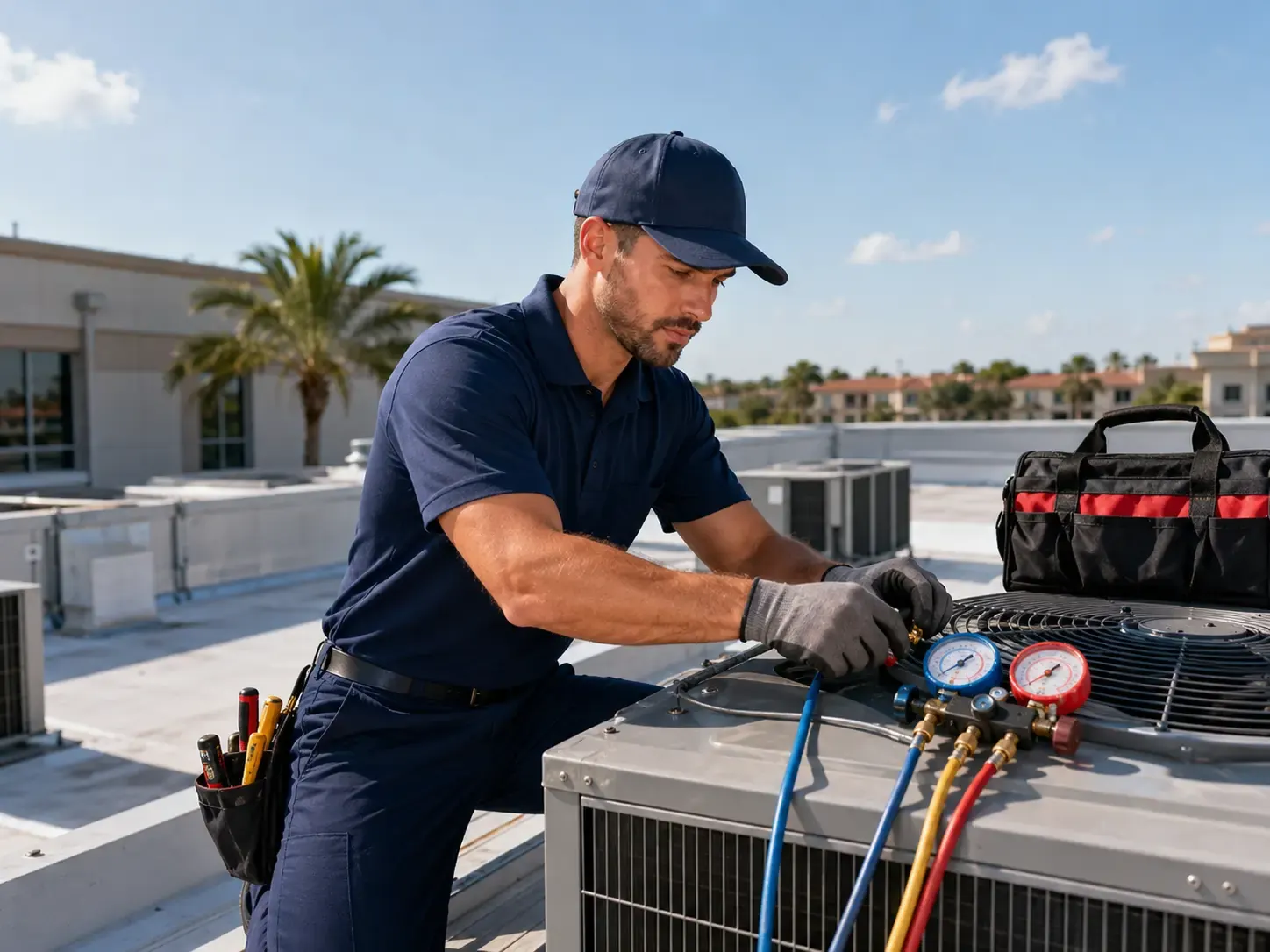
Most small-commercial cooling in Central Florida runs on packaged rooftop units. Common failures are electrical components, belt and blower problems, economizer and control faults, condensate drainage, and one failed stage of a multi-stage unit producing partial cooling. Access, unit size and refrigerant type drive both diagnosis time and cost.
Symptoms we hear about
- Cooling that keeps up in the morning but falls behind by afternoon
- One zone or one area of the building warm while others are fine
- Rooftop unit running with only partial cooling capacity
- Water on the roof, at a ceiling tile, or staining near a unit curb
- Repeated breaker trips on a rooftop circuit
- Loud belt squeal or vibration from a rooftop unit
Commercial equipment types you are likely to have
Packaged rooftop units
Compressors, coils, blower and controls in one cabinet on a roof curb, ducted down into the space. Dominant in retail, restaurants, offices and light industrial buildings. Multiple compressors or stages are common, which is why a rooftop unit can produce weak cooling instead of none.
Split systems in commercial use
Often found in smaller suites, converted spaces and older buildings. Diagnosis resembles residential work, but duty cycles, occupancy loads and ventilation requirements are heavier.
Multi-zone and VRF
Larger offices and mixed-use spaces may use variable refrigerant flow or multi-zone systems with sophisticated controls. Faults here are frequently control and communication issues rather than mechanical failures.
Dedicated equipment
Server rooms, kitchens and specialty spaces often have their own units with tighter tolerances. Ductless equipment is common for these — see ductless mini split repair.
Failures specific to commercial systems
- Belt-driven blowers — worn, loose or misaligned belts and worn sheaves reduce airflow long before they break
- Economizers — stuck dampers and failed actuators can pull hot, humid outside air into the building
- Multi-stage capacity loss — one failed compressor or stage yields partial cooling that is easy to mistake for undersizing
- Contactors and starters — high cycle counts wear contacts faster than in residential equipment
- Condensate management on a roof — clogged drains and pans cause roof and ceiling damage quickly
- Control and BAS integration — a scheduling or sensor fault can look exactly like an equipment failure
- Ventilation and exhaust interaction — kitchen exhaust that overwhelms make-up air pulls in humid outside air and destroys comfort
Corrosion deserves special mention: rooftop cabinets in Central Florida endure sun, heat, driving rain and storm debris continuously, which shortens the life of coils, fasteners, panels and electrical terminations.
How commercial diagnosis differs
- Confirm the control source first — thermostat, controller, or building automation schedule
- Determine how many stages or compressors should be operating and how many are
- Measure airflow-related indicators, including belt condition, blower speed and static pressure
- Check economizer position and outside-air introduction, which is a frequent hidden load
- Perform electrical measurements on each stage: capacitors, contactors, amp draw and voltage
- Evaluate refrigerant circuits individually, since multi-circuit units can have one healthy and one failed
- Inspect condensate drainage and roof-level water paths
- Consider building factors: occupancy changes, added kitchen or IT load, and duct condition
Roof access, safety requirements and coordination with building management add time that residential calls do not have. Providing access details when you request service prevents a wasted trip.
Business-impact realities
Cooling failures in commercial settings carry costs beyond the repair. Restaurants face food safety and staff conditions. Clinics have patient comfort and sometimes equipment requirements. Retail sees customers leave. Offices lose productivity, and humid indoor conditions can eventually affect finishes and inventory.
That is why partial-capacity failures deserve prompt attention rather than being nursed along. A rooftop unit running on one of two compressors will usually cope in the morning and fall behind in the afternoon, which is both uncomfortable and hard on the remaining circuit.
For after-hours failures, request service through the emergency AC repair page and describe the business impact and access constraints clearly.
Maintenance for commercial equipment
Commercial maintenance intervals are shorter than residential because run hours, filter loading and mechanical complexity are all higher. Quarterly or semi-annual service is typical, with monthly filter attention in high-load spaces such as kitchens and gyms.
- Filter changes on a documented schedule matched to the space
- Belt inspection, tension and alignment
- Coil cleaning on both sides, which rooftop units need more often than homeowners expect
- Electrical testing on every stage, including capacitance and amp draw
- Condensate pan, drain and roof-drainage inspection
- Economizer damper and actuator function testing
- Control verification against the intended schedule and setpoints
Documentation matters more in commercial settings, both for warranty claims and for budgeting replacement. See AC maintenance for the measurement-driven approach that applies to equipment of any size.
Cost planning and repair-versus-replace on rooftop units
Commercial repairs generally cost more than the residential equivalent because units are larger, refrigerant charges are bigger, crane or roof access may be required, and after-hours labor is common. The planning ranges on the cost page still apply directionally, but expect commercial work to land toward the upper end of the relevant band.
- Age and condition of the cabinet, not just the failed component
- Whether one circuit failing signals broader deterioration
- Refrigerant type and the cost to recharge a large system
- Rigging, curb adaptation and crane costs for replacement
- Downtime tolerance — sometimes a repair buys scheduled replacement later
- Efficiency gains against a long operating-hour profile
For many small businesses the best outcome is a repair now with a planned replacement in the shoulder season, when downtime is easier to absorb — see AC replacement.
Commercial AC Repair questions
- Do you handle commercial rooftop units in Orlando?
- Yes — requests for packaged rooftop units, commercial split systems and multi-zone equipment are welcome. When you call 904-913-1112, describe the unit type, how many units serve the space, and any roof access requirements so the visit can be scoped accurately.
- Why does my rooftop unit cool in the morning but not the afternoon?
- That pattern strongly suggests reduced capacity rather than a total failure — commonly one failed compressor or stage on a multi-stage unit, a dirty condenser coil, an economizer stuck open, or an airflow problem. The unit keeps up under a light morning load and falls behind as heat gain peaks.
- How often should commercial AC be serviced?
- More often than residential. Quarterly or semi-annual service suits most small commercial spaces, with monthly filter attention in kitchens, gyms and other high-load environments. Belts, coils and economizers in particular need frequent inspection on rooftop equipment.
- Is commercial AC repair more expensive than residential?
- Usually, yes. Larger capacity, bigger refrigerant charges, roof access and after-hours scheduling all add cost. The upside is that commercial equipment is often more serviceable component by component, so targeted repairs can restore capacity without replacing the whole unit.
- Can you work after business hours?
- After-hours requests are common for commercial work because daytime shutdowns are disruptive. Availability depends on scheduling and provider capacity, so call and describe the situation rather than assuming a fixed window. We do not promise a guaranteed arrival time.
- What is an economizer and why does it matter in Florida?
- An economizer brings in outside air when conditions make it useful for cooling. In humid Central Florida the payoff is limited, and a damper stuck open becomes a serious liability — it introduces hot, moist air continuously, raising both energy use and indoor humidity while masking the real problem.
- Should I repair or replace an aging rooftop unit?
- Consider cabinet and coil condition, refrigerant type, how many circuits remain healthy, rigging costs and your downtime tolerance. A frequent middle path is repairing now to restore capacity and scheduling replacement during a slower season when the shutdown is manageable.
Talk through your AC problem
Describe what the system is doing and ask about current service availability in your part of the Orlando area.
5401 S Kirkman Rd, Suite 3310 · Orlando, FL 32819